


Handcrafted Glass Art: Why It Outlasts Mass Production
Walk into an older church with original glass and you can often tell, within seconds, which panels were made by hand. The colors shift, the surfaces carry faint variations, and the light lands differently across the room. Mass-produced glass is not automatically fragile, but its manufacturing process leaves marks that matter over decades. This article explains why handcrafted glass art tends to hold up better, where the real differences show up, and how the glass artisan legacy is kept alive through careful making and restoration. We work with churches, homeowners, and commercial property owners in and around Leesburg, Virginia, so these are the questions we hear most often.
Table of Contents
Quick Takeaways
Key Insight | Explanation |
|---|---|
A mold seam reveals factory production | Machine pressing leaves a thin raised ridge where the two halves of a metal mold meet. Run a fingertip along a piece before you buy it. |
Cooling decides long-term durability | Annealing releases internal stress. Ask any studio how its pieces are annealed and how that schedule is set. |
Natural variation is a functional feature | Hand-worked glass bends light unevenly, which softens and moves the light in a room. Uniform factory glass often looks flat under the same lamp. |
Restoration usually beats replacement | Many cracked or bowing panels can be stabilized and releaded in place, which keeps original material and the window's history intact. |
Written specifications make bids comparable | Request glass thickness, cooling method, edge finish, and warranty terms in writing so every quote covers the same work. |
Test samples in the actual space | Glass that looks ideal in a showroom can look different at dusk, under warm bulbs, or in direct afternoon sun. |
What Separates Hand-Blown From Machine-Pressed Glass
The biggest difference between handcrafted and mass-produced glass starts with how the material is shaped. Machine-made pieces are formed on automated lines, where molten glass goes into metal molds and is pushed or blown into shape with compressed air or mechanical plungers. The process is fast and predictable, which is exactly why it dominates retail shelves.

Those mold-based methods leave evidence. When the two halves of a metal mold separate, they leave a thin raised seam along the glass. Run a fingertip along a factory-made globe or a pressed panel and you will often feel that ridge. Hand-blown work does not have one.
Where the Mold Shows Up in Finished Pieces
In practice, a mold mark tells you more than a sticker does. Machine-made pieces repeat the same shape many times, so a flaw in the mold reappears across every unit. A hand-blown piece is shaped in the air by a glassblower, so its wall thickness, curve, and proportions drift slightly from one piece to the next.
That drift is not a defect. It is evidence that a person made the object, and it is the reason two hand-blown pieces from the same design will never match perfectly.
Hot Shop Technique
A glassblower gathers molten glass from a furnace heated to more than 2,000 degrees Fahrenheit on the end of a hollow steel blowpipe. Using breath, hand tools, and gravity, the artist inflates and shapes the glass while it is still malleable. One lighting guide we reviewed argues that because the hot glass does not touch a cold iron mold during initial shaping, it cools more gradually and develops a more resilient structure. That principle is sound, but strength also depends on what happens next in the annealer.
Pro tip: When you visit a studio or inspect a sample, look at the base and rim first. Those areas show the most about how a piece was gathered, shaped, and finished.
How Glass Ages: Stress, Annealing, and Durability
Glass that looks finished on the day it leaves the studio can still hold stress inside it. How that stress is released is one of the most important differences between a piece built to last and one built to ship. This is where the hidden durability of handcrafted work comes from.
After forming, glass has to cool in a controlled way. The shaped piece goes into an annealing oven, where the temperature drops slowly so the internal structure can settle. Rushing or skipping this step leaves tension locked inside the material, and that tension is what leads to cracks that appear months or years later.
Why Annealing Is Not Optional
Annealing is the step most buyers never see, and it is the step that matters most for longevity. A careful studio schedules annealing around the size and thickness of each piece, because a thick vessel and a thin bowl cool at different rates. Ask how long a piece spends in the annealer and how that schedule is set. A vague answer usually means the step is not handled with much care.
Pro tip: Ask whether a piece has been annealed and whether the studio tracks its cooling schedule. A reliable maker will answer with specifics, not generalities.
Thermal Stress in Mass-Produced Pieces
Mass production runs fast, which makes it hard to give every piece a slow, individualized cooling process. The same lighting guide describes how rapid cooling against a cold metal mold can leave microscopic weak spots where the glass meets the metal. That is a claim worth taking seriously when you are choosing glass for a sunny window or a fixture that runs warm for hours.
Thermal stress shows up most when glass faces sudden temperature changes. A window that takes direct afternoon sun, a pendant near a hot bulb, or a panel beside a heating vent all subject glass to repeated expansion and contraction. The pieces that handle this best are the ones that were cooled slowly and deliberately from the start.
The lesson for buyers is simple. A low price on a thermally demanding installation can hide a durability problem that only appears after a few seasons of heat and cold.
Light Behaves Differently Through Handmade Glass
Glass does two jobs in a room. It transmits light, and it changes the light that passes through it. Handcrafted pieces tend to do the second job more interestingly because their surfaces and wall thicknesses are never perfectly uniform.
Light passing through a slightly uneven wall bends by slightly different amounts across its surface. The result is a soft, moving quality that flat, identical factory glass rarely produces. In a sanctuary or a lobby, that difference separates a room that is lit from a room that feels lit.
Refraction in Uneven Glass
Hand-blown glass often shows small waves, streaks, and bubbles that catch the light. Some buyers worry these are flaws, but they are what make a piece read as glass rather than a plain plastic substitute. A machine-made fixture tends to look bright at the source and flat everywhere else.
When you evaluate a sample, hold it against a window or a bright lamp and turn it slowly. Pay attention to how the color changes at the edge compared with the center. A piece with depth in that transition will look alive in a room.
The glass that looks plain on a showroom shelf is often the glass that reveals the most once the sun crosses it at the right angle.
Lighting Commercial and Worship Spaces
Lighting a commercial interior is a planning problem before it is a product choice. Decide where the light comes from, how bright the room needs to be, and which surfaces should be seen. Then choose glass that supports that plan instead of working against it.
Pro tip: Bring a sample to the actual room at the time of day when the space is used most. Glass that looks ideal at noon can look muddy at dusk under warm bulbs.
The Glass Artisan Legacy in Churches
The glass artisan legacy did not start in a showroom. Early glass artifacts date back to around 2000 BCE, with examples found in Mesopotamia and Egypt, and glassblowing had become widespread by the time of the Roman Empire. Each generation of makers built on the methods before it, which is why a single technique can carry centuries of practice inside it.
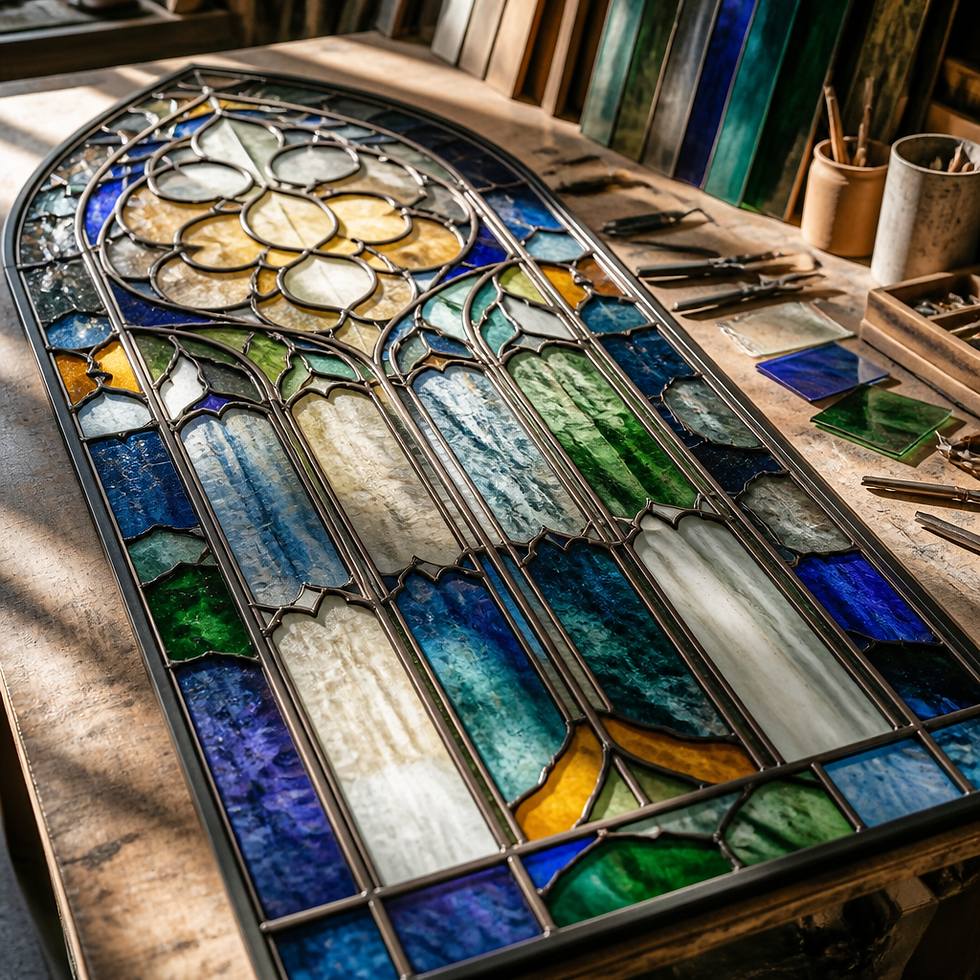
During the Renaissance, the Venetian island of Murano became a major center of glass artistry. Its makers developed techniques such as cristallo, a clear glass, and filigrana, which uses thread-like glass designs. Those names still appear in studios today, and the lineage matters to churches because sacred spaces are built to outlast the people who commission them.
Techniques That Carry Forward
Traditional methods such as blowing, casting, and flameworking remain in use because they solve real problems. They produce forms that cannot be made in a mold, and they let a maker adjust color and thickness during the work. A congregation that commissions a window is buying into that continuity, not just a picture on a wall.
Why Congregations Commission Handcrafted Work
Churches usually approach a glass project for one of a few reasons. An existing window is failing, a new building needs a focal point, or a memorial needs to be done properly. In each case, the question is not only how the glass looks on day one. The real question is how the window will look decades from now, after several maintenance cycles and a few hands have worked on the leading.
Plan for maintenance from the start. Ask for a written inspection schedule, document the leading and frame condition, and keep photographs of each panel. Those records often turn a future repair from a guessing exercise into a manageable job.
Custom Glass vs Mass Produced: Where the Difference Shows
Buyers often ask whether custom glass is worth the premium over a catalog option. The honest answer depends on how long the glass must perform and how much it must say about the building. For a decorative accent in a short-term rental, a standard piece may be enough. For a sanctuary window, an entrance, or a feature fixture that will stay for decades, the gap is significant.
The comparison below shows where the two approaches differ in practice. These differences appear at the first inspection, the first repair, and the first time someone asks where a piece came from.
Factor | Custom Handcrafted Glass | Mass-Produced Glass |
|---|---|---|
Forming method | Gathered, shaped, and worked by hand in a hot shop | Pressed or blown in metal molds on automated lines |
Surface detail | Natural variation with no repeating mold seam | Visible seam lines and near-identical pieces |
Cooling | Controlled annealing scheduled for each piece | Cooling set around production throughput |
Light quality | Uneven surface scatters and softens light | Uniform surface that often looks bright and flat |
Repairability | Individual panels can be matched, restored, or rebuilt | Replacement parts may be unavailable once a line changes |
Documentation | Materials and process can be specified in writing | Limited to a standard product sheet |
Reading a Bid Side by Side
When two quotes arrive, the lower number is not always the lower cost. Check whether each bid includes the same glass thickness, cooling method, edge work, and installation scope. A cheaper quote that leaves out annealing or frame repair is not a bargain, it is a deferred invoice.
Where Mass-Produced Glass Still Makes Sense
We will not pretend every project needs custom work. A temporary display, a low-stakes interior divider, or a budget rental renovation can be served well by a standard product. The mistake is applying that logic to a sanctuary window or a storefront entrance that will face weather, handling, and cleaning every day.
Restoration Over Replacement: Keeping the Original Glass
The most sustainable glass is often the glass already in the building. Restoration preserves original material, original craftsmanship, and the visual rhythm of a window or storefront that people already know. It also keeps decisions reversible, because a restorer can document each step.
Signs a Panel Can Be Saved
Cracked panels are not automatically lost. A crack that runs cleanly across a piece can sometimes be stabilized while the surrounding leading is rebuilt. Loose came, failed solder joints, and bowing panels are usually repairable as long as the glass itself is sound.
Look at the frame and the sill as well as the glass. Water trapped in a failed frame can do more damage than a single crack, so fixing the envelope is often part of the same job.
When Replacement Is the Honest Answer
Some glass is past saving. If a piece has widespread fracturing, staining that has penetrated the surface, or structural failure in its frame, replacement may be the only safe choice. A good restorer will say so plainly and explain the reasons in writing.
Pro tip: Photograph every panel from inside and outside before any work begins, then keep those photos with your building records. They become the baseline for every future repair decision.
What Commercial Property Owners Should Ask For
Commercial buyers usually focus on lead time, cost per square foot, and how the glass looks in a rendering. Those concerns are fair, but they miss the questions that determine whether the glass performs well five years in. The specification is where those questions get answered.

Storefront and Entry Glass
Storefront and entry glass takes daily wear from hands, weather, and cleaning crews. Custom glass lets you specify thickness, edge work, and finish for the exposure the glass will actually face. A standard catalog unit may satisfy a code requirement and still be the wrong choice for a west-facing entrance that takes full afternoon sun.
Writing a Specification That Protects You
Ask for the glass thickness, the cooling or tempering method, the edge finish, and the warranty terms in writing. Require the installer to name the frame and sealant products. A specification like that lets you compare bids on the same basis and gives your future maintenance team a record to work from.
At Aldie Glassworks in Leesburg, we write commercial specifications this way on every project because it protects both the owner and the fabricator. When everyone agrees on the details before fabrication starts, fewer surprises show up at installation.
Frequently Asked Questions
How can I tell handcrafted glass from mass-produced glass?
Look for a mold seam, which is a thin raised line where the two halves of a metal mold met. Hand-blown pieces usually lack a repeating seam and show small variations in wall thickness, color, and surface. Holding the piece against a light source will also show whether the color and texture shift naturally.
Does handcrafted glass last longer than machine-made glass?
It can, but the answer depends on the specific piece and how it was cooled. Careful annealing reduces internal stress, and that is the factor most tied to long-term durability. Ask any maker to explain its cooling process before you judge a piece on appearance alone.
Can old stained glass be repaired instead of replaced?
In many cases, yes. Cracked panels can often be stabilized, failed leading can be rebuilt, and bowing frames can be corrected. Replacement becomes the better option when fracturing is widespread or the frame has failed structurally.
What should a church ask for when commissioning a glass project?
Ask for a written description of materials, the process, and the expected maintenance schedule. Request photographs of comparable past work and ask how the glass will be documented for future repairs. Clear records make later work easier to plan and easier to price.
Is custom glass worth the cost for a commercial property?
For high-visibility or high-exposure locations, usually yes. Custom glass lets you specify thickness, finish, and edge work for the actual conditions. For low-exposure interior accents, a standard product may be the sensible choice.
Why does the glass artisan legacy matter to a homeowner?
A handcrafted piece carries technique, material knowledge, and a traceable origin that a homeowner can pass on. It also tends to be repairable, which keeps it in use longer and reduces the pull toward disposal.
Have you ever compared a handmade glass piece with a factory-made one in your own home or building, and what did you notice first?

Comments