


Stained Glass Restoration Services: The Complete Guide
- Brand Street Agency

- 3 days ago
- 10 min read
Stained glass panels in churches, historic courthouses, and commercial buildings across Northern Virginia are silently failing right now. Lead came corrodes, paint flakes from medieval-style figures, and structural panels bow outward under decades of thermal stress. Many property owners only notice the damage when a panel cracks or water intrudes. By that point, a straightforward repair has become a full restoration project. This guide gives churches, homeowners, and commercial property managers a clear-eyed look at how stained glass restoration services actually work, what they cost, and how to choose the right studio for work that lasts another century.
Table of Contents
Quick Takeaways
Key Insight
Explanation
Early intervention cuts costs sharply
Addressing corroded lead came before panels bow can reduce restoration costs by 40 to 60 percent compared to emergency panel replacement.
Protective glazing extends panel life by decades
Installing exterior protective glazing after restoration shields panels from UV, vandalism, and thermal shock without altering visual appearance from inside.
Not all glass studios handle historic documentation
Restoration work on properties listed on the National Register of Historic Places requires photographic and written documentation that most decorative studios are not equipped to provide.
Lead came has a finite service life
Standard lead came lasts 75 to 100 years under normal conditions. Virginia's humidity and freeze-thaw cycles accelerate oxidation, often shortening that lifespan.
Paint loss is irreversible without specialist intervention
Vitreous paint fired onto antique glass cannot be replicated exactly. Only studios with kiln-firing capability can stabilize flaking paint before it is permanently lost.
Structural support is as important as glass repair
Rebar armatures and saddle bars must be inspected and reset during restoration or repaired panels will bow again within a decade.
Commercial properties have different compliance needs
Commercial glass installations may require compliance with local building codes and energy standards, which affects the type of protective glazing system selected.
Why Restoration Cannot Wait
The single most expensive mistake property owners make is treating stained glass maintenance as optional. In practice, a panel that needs releading today will need full replacement in five years if ignored. Lead came oxidizes continuously, and once it loses flexibility, it cracks under normal wind load. That crack propagates to the glass itself.
Virginia's climate adds specific pressure. Leesburg and the broader Northern Virginia region experience genuine freeze-thaw cycling each winter. Water infiltrates microscopic gaps in failing lead, expands when it freezes, and widens those gaps. By spring, panels that looked stable in October are visibly bowing. This is not a slow process. A wet winter can accelerate deterioration that would otherwise take a decade.
Churches face particular risk because their windows are large, high, and often original to the building. Losing even one original panel is a permanent loss of irreplaceable craftsmanship. For commercial properties, the risk is more practical: a failed panel is a liability exposure and an emergency repair invoice that could have been a scheduled maintenance cost.


Diagnostic Assessment First
A credible stained glass restoration services provider starts with a thorough condition assessment, not a sales pitch. The assessment should document every panel in the installation, rank each one by urgency, and produce a written report the property owner can use to plan work over multiple budget cycles.
What a Proper Condition Report Covers
A complete condition report includes close-up photography of each panel, notation of lead came condition by quadrant, identification of cracked or broken glass, assessment of structural armature integrity, and documentation of any vitreous paint loss. It also notes evidence of prior repairs, because amateur repairs using silicone or incorrect solder create additional problems that must be resolved during proper restoration.
Prioritizing Panels for Phased Work
Most churches and large commercial properties cannot fund complete restoration in a single budget cycle. A proper assessment allows work to be phased by urgency. Panels rated critical, meaning active water infiltration or structural failure, are addressed first. Panels rated stable can be scheduled across two or three years. This approach makes historic glass repair Virginia accessible without requiring a single large capital outlay.
Pro tip: Request that your studio provide a photographic baseline of every panel before any work begins. This documentation is invaluable for insurance claims, grant applications, and verifying that restored work matches the original design.
Restoration Methods Compared
Three primary approaches exist for stained glass restoration, and choosing the wrong one wastes money or produces results that fail prematurely. The right method depends on the age of the glass, the extent of damage, and the historic significance of the installation.
Method
Best Suited For
Key Limitations
Full Releading
Panels where lead came is 75 or more years old, visibly oxidized, or structurally compromised across more than 40 percent of the panel surface
Requires complete disassembly; all glass must be removed, cleaned, and reset; higher cost but longest lasting result
In-Place Consolidation
Panels with localized lead failure where the majority of came is still sound; useful for stabilizing specific areas without full disassembly
Not appropriate for panels with widespread deterioration; requires skilled judgment to identify boundaries of sound came
Protective Glazing Installation
Panels that have been restored or are structurally stable but face ongoing environmental exposure; standard for exterior-facing historic windows
Does not address internal damage; must be properly vented to prevent heat and condensation buildup that accelerates deterioration
In practice, most historic installations require a combination of full releading for the most damaged panels and protective glazing across the entire installation once restoration is complete. Studios that recommend only one approach without evaluating the full installation are working from a template, not from the actual condition of your windows.
"The goal of authentic restoration is not to make a window look new. It is to stabilize and preserve what exists while returning the window to its intended visual integrity." - National Park Service Preservation Brief 33, Roofing for Historic Buildings guidance principles applied to stained glass conservation practice.
Historic Glass Repair in Virginia
Virginia has an unusually dense concentration of historically significant stained glass installations. Churches built between 1880 and 1940 in Northern Virginia often contain windows by studios that no longer exist, making authentic repair a genuine preservation challenge. The glass formulations, lead profiles, and painting techniques used in that era cannot be replicated exactly, but they can be closely matched by studios with deep material knowledge.
Working with the Virginia Department of Historic Resources
Properties listed on the Virginia Landmarks Register or the National Register of Historic Places may have access to state and federal tax credits for qualified restoration work. The Virginia Department of Historic Resources oversees this process. Restoration work that qualifies must meet the Secretary of the Interior's Standards for the Treatment of Historic Properties, which means documentation, material compatibility, and reversibility are all evaluated.
Not every glass studio is familiar with this process. Aldie Glassworks serves clients across Northern Virginia who need both the technical restoration work and the documentation required for historic tax credit applications. That combination of craft skill and administrative understanding is not common in the market.
Matching Antique Glass
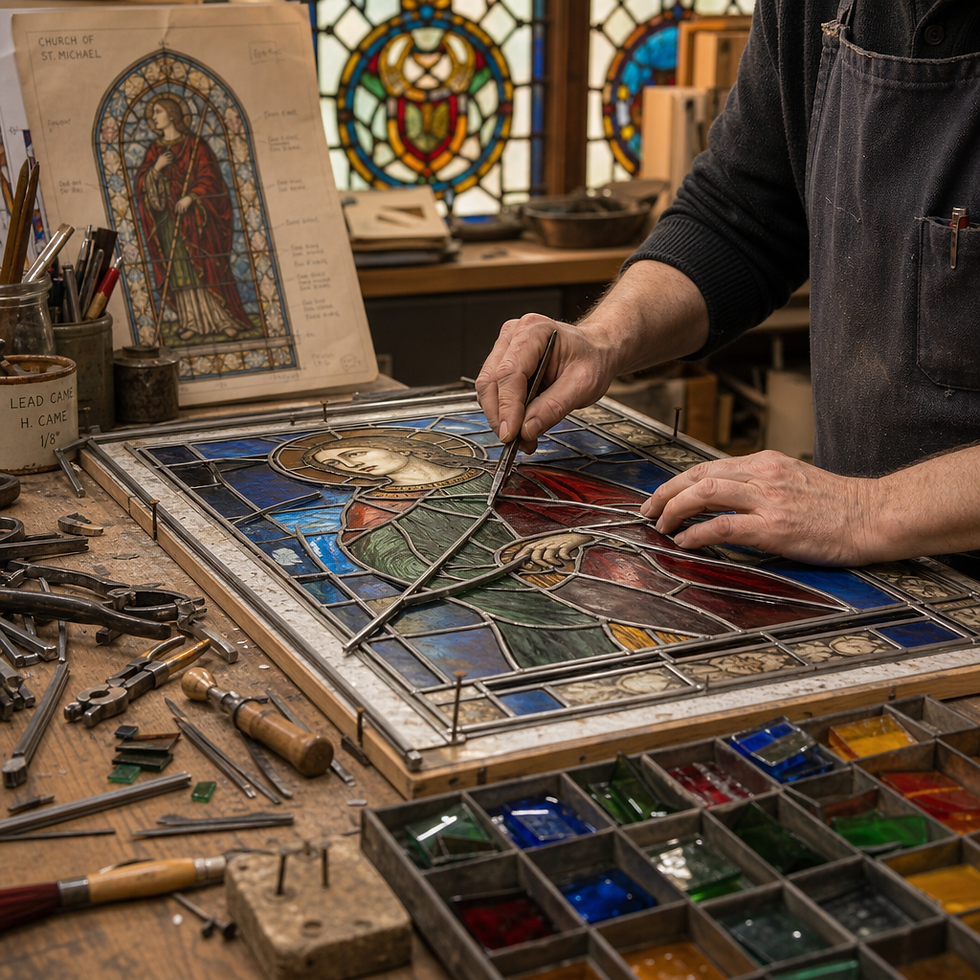
A frequent problem in historic glass repair Virginia projects is glass matching. When a single pane within a historic panel is cracked or missing, the replacement glass must match the original in color, texture, and transmission quality. Mouth-blown antique glass has surface variations and striations that modern float glass cannot replicate. Studios sourcing from specialized antique glass suppliers in Europe and from domestic specialty producers can achieve matches that hold up under close inspection. Studios using standard art glass from wholesale suppliers cannot.
Commercial Property Glass Restoration
Commercial property glass restoration operates under different constraints than residential or church work. Building owners face tenant expectations, insurance requirements, local code compliance, and the need to minimize disruption during restoration. Each of these factors influences how a project is scoped and executed.
Minimizing Business Disruption
For occupied commercial buildings, restoration work is typically phased to limit the number of panels removed at any time. Temporary weatherproof covers are installed over openings while panels are in the studio. Work schedules can be adjusted to avoid high-traffic periods. Property managers working with Aldie Glassworks in the Leesburg area have found that detailed pre-project scheduling resolves most disruption concerns before work begins.
A common mistake in commercial restoration is selecting a studio based primarily on price without evaluating their experience managing work in occupied buildings. The technical glass work may be identical, but the project management requirements are substantially different.
Architectural Glass Repair in Leesburg and Beyond
Architectural glass repair Leesburg encompasses more than stained glass windows. Decorative glass in transoms, sidelights, skylights, and interior partitions all require specialized care when damaged or deteriorated. The Leesburg historic district and surrounding Loudoun County contain properties with Victorian-era decorative glass that falls into this category.
Beveled and Textured Glass in Period Structures
Period homes and commercial buildings in Leesburg frequently feature beveled glass panels, jewel glass accents, and acid-etched surfaces that were standard decorative elements in late 19th and early 20th century construction. These elements require a different skill set than painted ecclesiastical glass, but the same principles apply. Material compatibility matters, structural integrity must be assessed before cosmetic repair, and replacement glass must be sourced to match the original.
New Installations Designed to Age Gracefully
Architectural glass repair sometimes reveals that an original installation was poorly designed for longevity. In those cases, restoration includes redesigning the structural system while preserving the visual character of the original work. This is not replacing history. It is correcting an original engineering deficiency before it causes further loss. For expert glass restoration Northern Virginia clients, this distinction matters because it affects both the restoration approach and the long-term maintenance plan.
Choosing the Right Glass Restoration Studio
The stained glass restoration market in Virginia includes studios ranging from skilled conservators with decades of experience to decorative glass shops that have added restoration to their service list without the training to support it. The difference matters enormously when the work involves irreplaceable historic glass.
Understanding Cost and Timeline
Stained glass restoration costs are driven by four factors: panel area, lead came condition, glass complexity, and access difficulty. A straightforward relead of a residential transom panel runs differently than a full restoration of a 20-panel church nave installation with painted figures and structural armature replacement.
Realistic Cost Ranges for Northern Virginia Projects
For planning purposes, full releading of standard residential or commercial panels in the Northern Virginia market typically runs between $300 and $600 per square foot, depending on glass complexity and lead profile requirements. Historic panels with vitreous paint, specialized glass matching, or documentation requirements cost more, often in the $400 to $700 per square foot range.
These figures assume professional studio work with proper materials. Cheaper bids almost always reflect shortcuts in lead quality, glass sourcing, or structural work that will surface as problems within a decade.
Timeline Expectations
A single residential panel restoration typically takes six to eight weeks from removal to reinstallation, including studio work and scheduling. A phased church restoration across 20 or more panels may run 18 to 36 months when balanced against budget cycles and seasonal installation windows. Summer and early fall are the optimal installation seasons in Northern Virginia, avoiding the freeze risk of winter installations and the humidity extremes of late summer.
Frequently Asked Questions
How do I know if my stained glass needs restoration or just cleaning?
Cleaning addresses surface dirt and atmospheric deposits. Restoration is required when you see bowing panels, cracked lead came, broken or cracked glass, active water infiltration, or flaking paint on the glass surface. If you press gently at a panel edge and feel movement, the structural integrity is compromised and cleaning alone will not resolve the problem. A condition assessment from a qualified studio is the only reliable way to determine the scope of work needed.
Can stained glass be restored in place without removing it from the building?
In-place consolidation is possible for localized damage where the majority of the panel structure is sound, but full releading always requires removal. Attempting to relead panels in situ produces inferior results because the glass cannot be fully cleaned, solder joints cannot be properly finished, and the new lead matrix cannot be tensioned correctly. Any studio that offers full releading without panel removal is describing a process that will not hold up over time.
What is protective glazing and does every restored panel need it?
Protective glazing is a separate exterior glass system installed over restored stained glass panels. It shields panels from wind load, UV exposure, temperature extremes, and vandalism without altering the appearance from inside. For exterior-facing church windows and exposed commercial installations in Northern Virginia, protective glazing is strongly recommended after restoration. It is not cosmetically necessary but dramatically extends the service life of the restored work.
Will restoration change the appearance of my historic windows?
Authentic restoration preserves visual character. Lead came profiles are matched to the originals. Glass is sourced to match in color and texture. Vitreous paint is stabilized, not repainted. A properly restored window looks as it did when it was installed, not as though it was replaced with new work. Studios that cannot explain specifically how they match materials to originals are not doing authentic restoration.
Are there grants or tax credits available for stained glass restoration in Virginia?
Yes. Properties listed on the Virginia Landmarks Register or the National Register of Historic Places may qualify for the Virginia Historic Rehabilitation Tax Credit, which covers 25 percent of qualified rehabilitation expenses, and the Federal Historic Tax Credit, which covers 20 percent. Churches, as nonprofit entities, may access different incentive structures. Grant programs through the Virginia Department of Historic Resources and private preservation foundations also exist. A studio familiar with historic documentation requirements can help clients position restoration projects for these programs.
How long should a professional stained glass restoration last?
A full relead using quality lead came and proper structural armature work should last 75 to 100 years under normal conditions, which is consistent with the original service life of well-made historic installations. Protective glazing and periodic maintenance inspections every 10 to 15 years extend that lifespan further. Restorations using inferior lead or skipping structural armature work may begin showing problems within 20 to 30 years.
What is the difference between a stained glass artist and a stained glass conservator?
A stained glass artist creates new work. A conservator specializes in preserving and restoring existing work, which requires additional expertise in historic materials, documentation methods, and conservation ethics. Many studios do both, but their primary orientation matters. For restoration of historic or architecturally significant glass, you want a studio with genuine conservation experience, not just artistic skill applied to old glass.
If you manage a church, historic property, or commercial building with stained glass in Northern Virginia, we would like to hear about the specific challenges you are facing. What has been the hardest part of finding qualified restoration help in this region?


Comments