


How to Commission a Stained Glass Window for Your Church
Most church committees approach a stained glass commission the same way they approach buying a piece of furniture: they look at pictures, pick a style, and ask for a price. That approach almost always ends in frustration, cost overruns, or a finished window that fails to serve the congregation's spiritual and architectural needs. Commissioning a stained glass window is a collaborative creative process, not a product transaction. When done right, it results in an installation that transforms the atmosphere of your sanctuary and endures for generations. This guide walks you through every step, from forming your committee to receiving the finished installation.
Table of Contents
Quick Takeaways
Key Insight | Explanation |
|---|---|
Start with theology, not aesthetics | A church window's primary job is to communicate faith. Design decisions follow from theological content, not the other way around. |
Form a small, decisive committee | Large committees stall projects. A group of three to five people with clear roles keeps the process moving and decisions accountable. |
Site assessment before any design work | Light direction, architectural framing, and existing glazing all shape what the new window can and should do. A studio that skips this step is a red flag. |
Design fees are normal and appropriate | Skilled design work takes time. Expecting free preliminary designs devalues the most creative part of the commission and usually attracts studios that cut corners. |
Budget for the full project, not just the glass | Installation, structural reinforcement, and long-term maintenance are part of the true cost. A detailed scope of work protects against surprises. |
Allow adequate lead time | A well-executed custom church window commission typically takes several months from first consultation to installation. Rushing the process compromises craftsmanship. |
Get approval rights in writing | Your contract should specify how many design revisions are included and at which stages the congregation has formal sign-off before fabrication begins. |
Why Church Stained Glass Is Different from Other Custom Glass
A custom stained glass window for a residence is designed to delight one family and suit one architectural setting. A window for a church carries a fundamentally different responsibility. It must communicate a theological message to a diverse congregation over many decades, sit in harmony with the existing visual language of the building, and hold its structural and aesthetic integrity through seasons of temperature change, humidity, and direct sunlight.
The windows in a church are not decoration. They are a form of teaching, a permanent visual statement of what the congregation believes and values. That means the content, iconography, and color palette are not simply matters of personal taste. They require careful thought about liturgy, scripture, and how worshippers will experience the light at different times of day and year.
A stained glass window's role in a church is not simply to commemorate people or events. It exists to create a space in which faith is illuminated, literally and figuratively. Every design decision should serve that purpose first.
This distinction changes everything about how you approach the commission. Studios experienced in residential or commercial architectural glass are not automatically equipped for church work. Custom church glass demands a practitioner who understands iconographic tradition, the behavior of colored light in a worship context, and the structural requirements of large ecclesiastical openings.


Forming Your Commission Committee
One of the most predictable ways a church stained glass project goes wrong is committee structure. When too many voices carry equal weight, the process bogs down in competing preferences and the resulting design becomes a compromise that satisfies no one fully. A better structure is a small working group with clear roles and genuine authority to make decisions.
Who Should Be on the Committee
A functional commission committee typically includes the lead clergy member or a delegate with theological authority, one person with visual arts or architectural background (even an interested layperson with relevant experience), someone responsible for fundraising and budget oversight, and one or two congregation representatives who reflect the community's range of perspectives. Five people is usually the ceiling. Beyond that, every meeting becomes a negotiation.
The committee's job is not to design the window. That is the studio's job. The committee's job is to articulate what the congregation needs the window to communicate, to evaluate designs against that brief, and to make timely decisions so the project keeps moving.
Establishing Decision-Making Authority
Decide early who has final sign-off. This is most commonly the senior pastor and vestry chair together, or the full vestry for significant projects. Whatever the structure, make it explicit from the start. A studio cannot work effectively if design approvals require a congregational vote every time a detail changes. Build a chain of authority that is fast enough to respect the craftsman's time and clear enough to avoid internal disputes later.
Pro tip: Draft a one-page internal brief before you approach any studio. Include the theological subject matter, the architectural context, your approximate budget range, and your target installation date. This document makes your first conversation with a prospective studio far more productive and signals that your congregation is a serious, prepared client.
Defining the Brief: Theology, Architecture, and Light
The brief is the foundation of the entire commission. A vague brief produces a vague window. A specific, well-considered brief gives the artist genuine material to work with and dramatically increases the chance of a result that moves and serves your congregation.
Theological Content and Iconography
Begin with the question: what do we want this window to say? That is a theological question before it is a visual one. Is the window commemorating a person or an event in the church's history? Is it depicting a scriptural narrative? Is it expressing an abstract theological concept such as grace, resurrection, or light itself? The answer shapes every downstream decision about imagery, color, and composition.
A common mistake is allowing the donor's personal preferences to drive the iconographic content. A donor's favorite saint or subject is a valid starting point for conversation, but it does not automatically produce a window that serves the whole congregation. The committee's role is to translate personal generosity into communal meaning.
Architectural Context and Light Conditions
The physical setting of the window is as important as the subject matter. A north-facing window receives cool, diffuse light for most of the day. A south- or west-facing window will flood the interior with warm, direct light at specific times of day. These conditions affect which colors read well, which wash out, and how the window behaves during services.
A proper site assessment documents the window's dimensions, the framing materials and condition, the existing glazing in adjacent openings, the direction and intensity of light throughout the day, and any structural or preservation constraints on the building. Historic church buildings in Virginia, particularly in the Northern Virginia region around Leesburg, often carry preservation requirements that govern the style, materials, and methods permitted for new glazing work. Know those constraints before the design process begins.
Pro tip: Photograph the empty window opening at different times of day across at least one full day, ideally in both summer and winter conditions. These images give your studio invaluable information about the actual light environment and help them design a window that performs well year-round, not just in the studio under artificial light.
Selecting the Right Studio
Selecting the studio that will execute your commission is the single most consequential decision in the entire process. The quality gap between studios working in this space is significant, and price alone is a poor guide to quality.
What to Look for in a Stained Glass Studio
You want a studio with demonstrable experience in ecclesiastical work, not just residential or decorative commissions. Ask to see completed church installations, not just renderings. Ask about the studio's design process: do they produce preliminary sketches and full-scale cartoons before fabrication begins? Do they conduct site visits as a standard part of the process, or do they work from measurements alone? The answers reveal how seriously they take the commission context.
Look also at how the studio handles the collaborative relationship. A good studio listens carefully, asks probing questions about your congregation's needs, and brings its own artistic perspective to the dialogue. A studio that simply executes client instructions without pushback is not giving you its best work. Some productive tension between the artist's vision and the committee's brief is a sign of a healthy process.
Working with a Northern Virginia Studio
For churches in Northern Virginia, working with a local or regional studio carries practical advantages beyond geography. A studio based in the region understands the architectural character of local worship spaces, can conduct site visits efficiently, and is accessible for in-person design reviews during the approval process. For a commission as significant as a custom church window, that proximity matters at every stage.
Aldie Glassworks, based in Leesburg, Virginia, brings that combination of regional presence and specialized expertise to ecclesiastical commissions throughout Northern Virginia. The studio's work spans custom glass installations, architectural glass design, and restoration services, giving church committees a single point of contact for new commissions and for the care of existing historic glass.

The Design Process: From Concept Sketch to Full Cartoon
The design phase is where the commission truly begins. It is also where many church committees underestimate how much work is involved and how much their active participation shapes the outcome.
Concept Sketches and Design Iterations
After the initial consultation and site assessment, the studio typically produces one or more concept sketches. These are not finished designs. They are explorations of compositional approaches, color relationships, and iconographic possibilities. The committee's role at this stage is to respond substantively: not just "we like this" or "we don't like that," but to articulate what is working theologically and architecturally and what is not.
Occasionally a design will require several rounds of revision before both the studio and the committee are genuinely satisfied. That is normal and healthy. Rushing through this phase to get to fabrication is one of the most expensive mistakes a committee can make. Changes to a design during fabrication cost far more in time and materials than changes on paper.
The Full-Scale Cartoon
Once the concept design is approved, the studio produces a full-scale cartoon. This is a precise, life-size line drawing of the entire window that establishes exactly where every piece of glass will fall, where the lead lines run, and how the composition reads at actual scale. The cartoon is the master document for the entire fabrication process.
Reviewing the cartoon is a critical committee responsibility. What reads well in a small sketch can look very different at full scale. This is the last practical opportunity to request changes before cutting begins. Take it seriously.
Materials and Fabrication: What Actually Goes Into the Window
Understanding the fabrication process helps church committees make informed decisions about quality and cost. The materials used in a commission directly affect how the window looks, how it performs over time, and how much it costs to maintain.
Antique and Mouth-Blown Glass
The highest quality stained glass for ecclesiastical work is mouth-blown antique glass, sometimes called pot-metal glass, made using techniques largely unchanged from medieval practice. This glass has a subtle variation in thickness, color depth, and surface texture that machine-rolled glass cannot replicate. It catches and transmits light in a way that gives the finished window a luminosity and depth that is immediately apparent in a worship setting.
Hand-blown glass typically costs more per square foot than machine-rolled glass, and certain colors and textures may be available from only a limited number of specialist manufacturers. A good studio will show you actual glass samples during the design process so you can evaluate color and texture in real light rather than relying on printed representations.
Lead Came and Structural Reinforcement
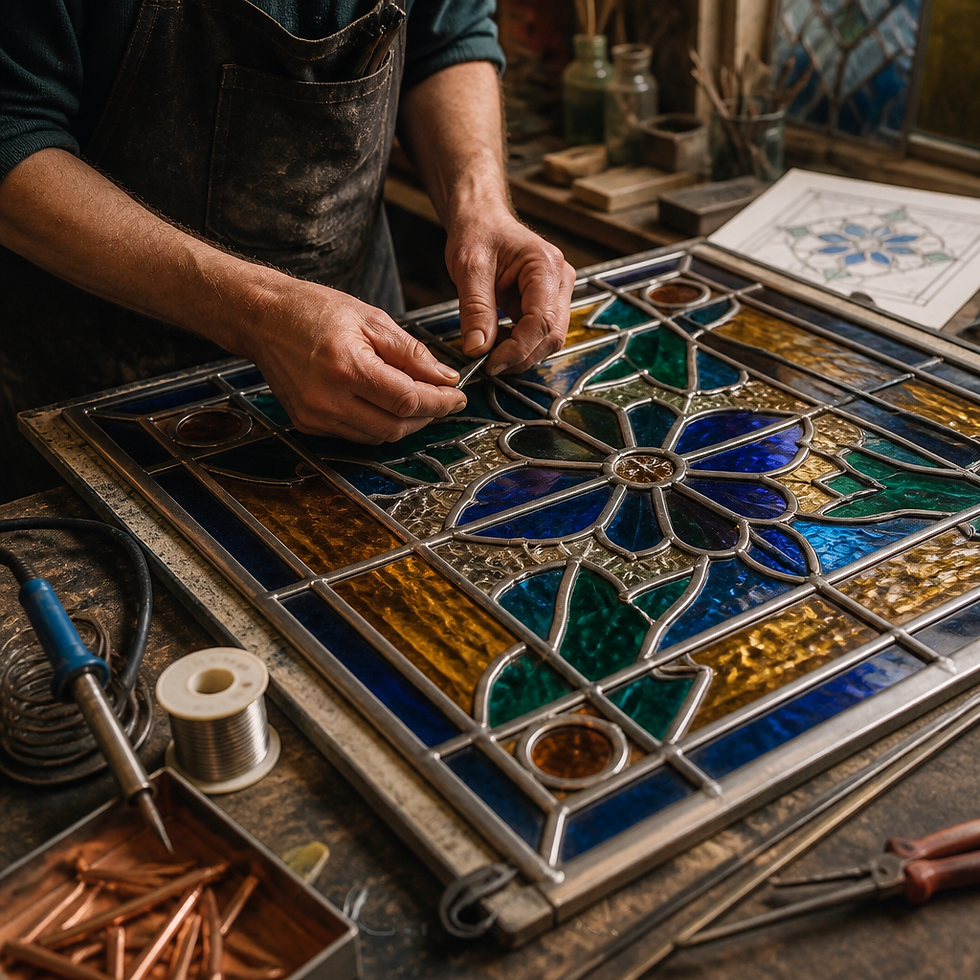
The lead matrix that holds the glass together is called came. Its profile, width, and quality affect both the structural integrity of the panel and the visual character of the composition. Heavier lead lines create a bolder, more graphic effect. Finer lead lines allow more color to read but require more precise cutting and a more careful fabrication process.
Structural reinforcement, typically steel or stainless steel bars set into the window frame and attached to the glass panels with copper ties, is essential for windows above a certain size. Without adequate reinforcement, panels bow and distort over time, which stresses the lead joints and accelerates deterioration. The structural design of the window should be part of the studio's scope from the beginning, not an afterthought at installation.
Budgeting and Timeline: What to Expect
Budget conversations make many church committees uncomfortable, but avoiding them early creates far larger problems later. A studio that will not discuss budget ranges in the initial consultation is not a good partner for a project of this scale.
What Drives Cost in a Church Commission
The two dominant cost factors in any stained glass commission are the size of the window and the intricacy of the design. A larger window requires more glass, more lead, more labor, and more time. A more intricate design, with fine detail, complex figure work, or densely composed imagery, requires a higher level of skill and significantly more fabrication time than a simpler geometric or abstract design.
Glass type also affects cost. As discussed above, mouth-blown antique glass commands a premium over machine-rolled glass. Certain specialty glasses, particularly unusual colors or textures, may carry additional cost that should be identified early in the material selection process.
Do not budget for the glass alone. Installation costs, which include structural work, any necessary repairs to the opening or frame, and the logistics of working at height in a functioning building, are a real component of the total project cost. So is ongoing maintenance: a well-crafted window designed with maintenance access in mind is a better long-term investment than one that is difficult and expensive to service.
Realistic Timeline Expectations
A custom church commission of any meaningful complexity takes time. From the first consultation through design approval, fabrication, and installation, a project can span many months. Larger, more complex commissions may take longer. Churches planning a window installation to coincide with an anniversary, dedication, or liturgical milestone should initiate the commission process well in advance of that date, ideally allowing at least a year of lead time for significant projects.
Fabrication cannot be rushed without compromising quality. Lead came must be properly soldered and cement-filled to create a weatherproof, structurally sound panel. Paint and stain applied to the glass surface must be kiln-fired at precise temperatures to achieve permanence. These are processes with fixed timelines that cannot be compressed without risk to the finished window.
Installation and Long-Term Care
Installation day is not the end of the commission. It is the transition from creation to stewardship. A church that cares for its glass properly protects a significant investment and ensures the window serves future generations as well as the present congregation.
The Installation Process
Professional installation requires precise fitting of the panels into the window opening, proper seating and caulking to exclude water, and secure attachment of the structural reinforcement to the building frame. In historic buildings, this work must be done with care to avoid damage to original stone, brick, or wood framing. Your studio should have experience working in ecclesiastical buildings and should carry appropriate insurance for work at height and in occupied structures.
After installation, the new window should be inspected from inside the building at different times of day. The committee and clergy should walk through what was agreed in the brief and confirm that the installed window delivers what was promised in the design approvals. This is a final quality check, not an opportunity to reopen design decisions. If something is genuinely wrong, address it immediately through the studio's warranty or remediation process.
Protecting Your Investment Over Time
Stained glass windows in churches are exposed to thermal cycling, moisture, physical vibration, and vandalism risk. Protective glazing, a secondary layer of clear glass or polycarbonate installed on the exterior of the window, is one of the most effective ways to extend the life of a significant commission. It reduces wind-driven rain penetration, buffers temperature fluctuations, and provides a measure of protection against impact.
Regular inspection by a qualified conservator, typically every five to ten years depending on the building's environment, catches minor deterioration before it becomes a major structural problem. The cost of early intervention is a small fraction of the cost of a full panel replacement. Aldie Glassworks' restoration and conservation services are available to Northern Virginia churches that want a structured maintenance program for both new commissions and historic glass.
Comparing Commission Approaches
Approach | What It Involves | Best Suited For |
|---|---|---|
Full Custom Commission | Original design developed specifically for your building, congregation, and theological brief. Includes site assessment, concept development, full-scale cartoon, hand-fabrication, and installation. Every element is unique. | Churches seeking a permanent, congregation-specific work of art. The highest investment in quality, longevity, and meaning. |
Adapted Pattern Commission | An existing iconographic template or compositional layout is adapted to your window dimensions and color preferences. Less intensive design phase, but some creative limitations. | Smaller budgets or lower-priority openings where a fully original design is not essential. Acceptable for secondary windows. |
Restoration with New Insertions | Existing historic glass is repaired and stabilized. Damaged or missing sections are replaced with new glass designed to integrate seamlessly with the original. Requires deep knowledge of historic techniques and materials. | Historic churches with valuable existing glass that needs repair. Preservation of heritage and continuity of visual character is the priority. |
Frequently Asked Questions
How long does it take to commission a stained glass window for a church?
From first consultation to completed installation, a full custom church commission typically takes several months at minimum. More complex or larger projects may take considerably longer. Churches planning for a specific dedication date should begin the process at least a year in advance. The design and approval phase alone can take weeks or months depending on committee responsiveness and the number of revision cycles required.
What should be included in the commission contract?
A well-structured contract should specify the full scope of work, including design, fabrication, delivery, and installation. It should define how many design revisions are included before additional fees apply, identify the specific approval stages and who holds sign-off authority, set out the payment schedule, and include the studio's warranty terms. It should also address what happens if either party needs to change the timeline or scope.
How is the cost of a custom stained glass window calculated?
Cost is primarily driven by the window's size and the intricacy of its design. A more complex design with detailed figure work, fine lead lines, and specialty glass requires significantly more labor and skill than a simpler geometric or abstract composition. Materials, including the grade of glass selected, also affect cost. Installation, structural reinforcement, and protective glazing are additional cost components that should be included in the total project budget from the outset.
Can we commission a window to match existing historic glass in our church?
Yes, and this is one of the most technically demanding types of commission. It requires careful analysis of the existing windows' color palette, lead line character, paint technique, and glass type. A studio experienced in historic restoration work can source period-appropriate materials and employ techniques that produce a new panel visually consistent with older work. This is not a task for a studio without specific restoration expertise.
Do we need planning or heritage approval before commissioning a new window?
It depends on the age and listed status of your building. In Virginia, churches that are listed on state or national historic registers, or that are subject to local historic district regulations, may need to obtain approval from the relevant preservation authority before installing new glazing or altering existing windows. Your studio should be familiar with these requirements and able to advise you. It is worth checking with your diocese or local preservation office early in the process to avoid delays.
What is the difference between stained glass and painted glass in a church window?
Traditional stained glass uses pieces of colored glass cut to shape and assembled with lead came. The color is intrinsic to the glass itself. Painted details, shading, and fine line work are achieved with vitreous paint applied to the glass surface and permanently fused in a kiln. Most high-quality ecclesiastical windows combine both techniques: the base colors come from the glass, while fine figurative details and tonal modeling come from kiln-fired paint. Studios that rely solely on paint over clear glass are producing a fundamentally different and generally less durable product.
How do we find and engage a qualified studio for stained glass for churches in Virginia?
Start by looking for studios with documented ecclesiastical work in your region. Request references from other churches and visit completed installations in person. Ask about the studio's design process, site assessment practices, and familiarity with the specific challenges of the building type you have. For churches in Northern Virginia, working with a regional studio that can attend site visits in person and participate in in-person design reviews is a significant practical advantage. Aldie Glassworks in Leesburg serves church clients across Northern Virginia and brings specialist expertise in both new commissions and historic glass conservation to every project.
Have you recently navigated a church stained glass commission, or are you at the beginning of the process? We would love to hear about the challenges your committee is working through and what questions remain unanswered.
References
Step-by-step guide to commissioning stained glass for a parish church
How to commission a contemporary stained glass window from an artist
Overview of the stained glass commission process from consultation to installation
Factors that determine cost in a custom stained glass commission
Designing and fabricating a new church stained glass window commission


Comments